The history of the web is often simplified into a few famous names: Mosaic, Netscape, and later Internet Explorer. But when the question is more precise — the creation of the first graphical web browser — the answer starts earlier.
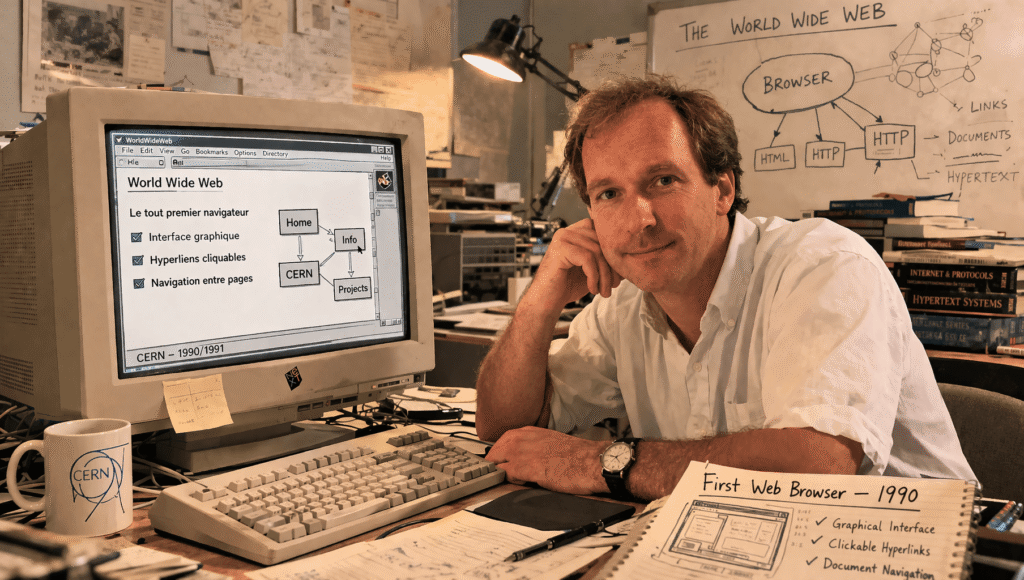
Before the web became a mainstream visual medium, it was a technical environment built mainly for researchers. Navigation was text-based, interaction was limited, and the user experience was far from intuitive. The turning point came when Tim Berners-Lee created WorldWideWeb in 1990, the first web browser with a graphical interface.
This article explains what that browser really was, why it did not immediately transform the internet, and why later browsers such as Mosaic played a decisive role in the public adoption of the web.
Table of Contents
What was the first graphical web browser?
The first web browser with a graphical interface was WorldWideWeb, created by Tim Berners-Lee at CERN in 1990.
This software was later renamed Nexus to avoid confusion with the World Wide Web itself. From a historical and technical point of view, it is the true starting point of graphical web navigation.
That distinction matters because many people wrongly assume that Mosaic was the first graphical browser. Mosaic was not the first. It was the browser that popularized the concept on a much larger scale.
Why WorldWideWeb was a major technical breakthrough
WorldWideWeb introduced a radically different way of interacting with online information.
Instead of relying entirely on command-line input, the browser offered:
- multiple windows
- menus and clickable links
- a visual document interface
- editing capabilities inside the browser
This last point is particularly important. WorldWideWeb was not only a browser. It was also an editor, which reflected Tim Berners-Lee’s original vision of the web as a read-and-write space, not just a read-only medium.
In other words, the first graphical browser was designed for collaboration as much as navigation.
The original vision behind the first graphical browser
Tim Berners-Lee did not create the web simply to display documents. His goal was to build a universal information system that would allow researchers to share, edit, and connect knowledge more easily.
That is why WorldWideWeb was so important conceptually. It showed that the web could become:
- a visual interface for documents
- a network of interconnected pages
- a collaborative environment
Even though the interface was primitive by modern standards, it represented a major shift away from text-only access.
Why the first graphical browser remained relatively unknown
If WorldWideWeb was the first graphical browser, why do so few people know about it?
The main reason is simple: limited accessibility.
WorldWideWeb only ran on NeXTSTEP, the operating system used on NeXT computers. These machines were powerful but expensive and far from common. As a result, the browser remained confined to a small academic and research environment.
Several factors limited its adoption:
- it worked only on NeXTSTEP
- NeXT hardware was rare and costly
- its early distribution stayed within research circles
- the broader public had no practical access to it
So while WorldWideWeb was first in technical terms, it was not the browser that introduced the masses to visual web browsing.
The web before graphical browsing
To understand the impact of WorldWideWeb, it helps to remember what browsing looked like before graphical interfaces.
Text-only navigation
Early browsers such as the Line Mode Browser displayed web content in a plain text format. There were no visual layouts, no embedded media, and no mouse-driven navigation in the modern sense.
Users interacted with pages through keyboard commands and numbered links. This was functional, but it was not attractive for the general public.
The limitations of a text-only web
A purely textual web was useful for technical users, but it had obvious limits:
- low visual engagement
- poor accessibility for non-technical users
- limited use for images, design, and layout
- reduced appeal outside research communities
The infrastructure of the web already existed, but the user-facing layer was not yet ready for mass adoption.
Mosaic: not the first, but the browser that changed everything
If WorldWideWeb created the first graphical model, NCSA Mosaic changed the scale of adoption.
Released in 1993, Mosaic introduced a more accessible and visually compelling browsing experience. Its most important breakthrough was the ability to display images directly inside web pages, rather than opening them in separate windows.
This change may seem minor today, but at the time it fundamentally transformed how people perceived the web.
Mosaic also benefited from something WorldWideWeb lacked: cross-platform availability.
- Unix systems
- Macintosh
- Windows
That made the web available to a much larger audience. The internet was no longer just a research tool. It was becoming a visual public medium.
WorldWideWeb vs Mosaic: invention versus democratization
One of the most important distinctions in browser history is the difference between technical invention and mass adoption.
| Feature | WorldWideWeb / Nexus | NCSA Mosaic |
|---|---|---|
| Creator | Tim Berners-Lee | Marc Andreessen and Eric Bina |
| Launch year | 1990 | 1993 |
| Main role | First graphical web browser | First widely adopted graphical browser |
| Operating system | NeXTSTEP only | Unix, Mac, Windows |
| Visual innovation | Graphical navigation and editing | Inline images and broader usability |
| Audience | Academic and research users | General public and wider computing audience |
This distinction explains why both browsers matter in different ways. WorldWideWeb came first. Mosaic made the web explode commercially and culturally.
Why the first graphical interface mattered for the modern web
The creation of the first graphical browser changed more than the appearance of pages. It changed the logic of digital interaction.
Once the web became visual, several long-term consequences followed:
- navigation became easier for non-technical users
- design and layout became central to web publishing
- clickable interfaces replaced command-based interaction
- user experience became a strategic discipline
From there, the web gradually evolved from static documents to interactive websites, and later to full web applications.
From graphical browsing to modern UX
Today’s web browsers are no longer simple document viewers. They are complex runtime environments capable of supporting applications, collaboration tools, streaming, payments, and cloud software.
But that evolution began with a simple shift: moving from text-only interaction to a graphical interface.
The legacy of the first graphical browser can still be seen in several areas:
- click-based navigation
- visual hierarchy in web design
- integrated editing environments
- the importance of UI and UX in digital products
In that sense, the creation of the first graphical web browser was not just a technical milestone. It was the foundation of the modern web experience.
The lasting legacy of WorldWideWeb
Even if it never achieved mass adoption, WorldWideWeb remains one of the most important pieces of software in internet history.
It proved that:
- the web could be visual
- hyperlinks could be navigated through an interface
- browsing and editing could coexist
That conceptual legacy continues to influence content management systems, collaborative editors, and browser-based software today.
Conclusion
The creation of the first browser with a graphical interface belongs to WorldWideWeb, developed by Tim Berners-Lee in 1990.
That browser introduced the idea of visual, clickable web navigation long before the web became mainstream. However, it was Mosaic in 1993 that democratized this experience by making it accessible, visual, and widely distributed.
Understanding this distinction matters because it clarifies a recurring confusion in digital history: the first invention and the first mass success are not always the same thing.
WorldWideWeb invented the model. Mosaic scaled it. Together, they shaped the web we still use today.
You might not think about it at first, but the evolution of web browsers — from the first graphical interface to modern platforms — has deeply changed how we interact with data online. Today’s browsers are not just tools to display content; they are gateways to personal information, accounts, and sensitive data.
As web technologies became more visual and accessible, they also introduced new risks. Every click, login, and interaction can expose part of your digital identity if basic precautions are not taken.
That’s why understanding how to browse safely is just as important as understanding how the web was built. If you want to go further, you should learn how to protect your digital data effectively, especially when using modern browsers and online services.
FAQ
What was the first graphical web browser?
The first graphical web browser was WorldWideWeb, created by Tim Berners-Lee in 1990 at CERN.
Was Mosaic the first graphical browser?
No. Mosaic was not the first graphical browser, but it was the browser that popularized graphical web navigation for a wider audience.
Why was WorldWideWeb renamed Nexus?
It was renamed to avoid confusion between the browser itself and the World Wide Web as a broader system.
Why did WorldWideWeb remain limited in adoption?
Its use was restricted by its dependence on the NeXTSTEP operating system and the limited availability of NeXT computers.
Why was Mosaic so important?
Mosaic was important because it made the web more visual and accessible, especially by displaying images directly within pages and supporting multiple operating systems.