AI for creating images has fundamentally changed the worlds of design, marketing, illustration, and digital content creation. Tasks that once required hours of work can now be completed in minutes using advanced image-generation models capable of transforming text prompts into original visuals.
But how far can these technologies really go? Can they replace human creators, or are they simply powerful tools that enhance creativity and productivity?
To answer these questions, it’s important to understand how image-generation AI works, where it excels, and where its limitations remain.
Table of Contents
What is AI for creating images?
How image-generation AI works
AI image generators rely on machine learning models trained on massive collections of visual data.
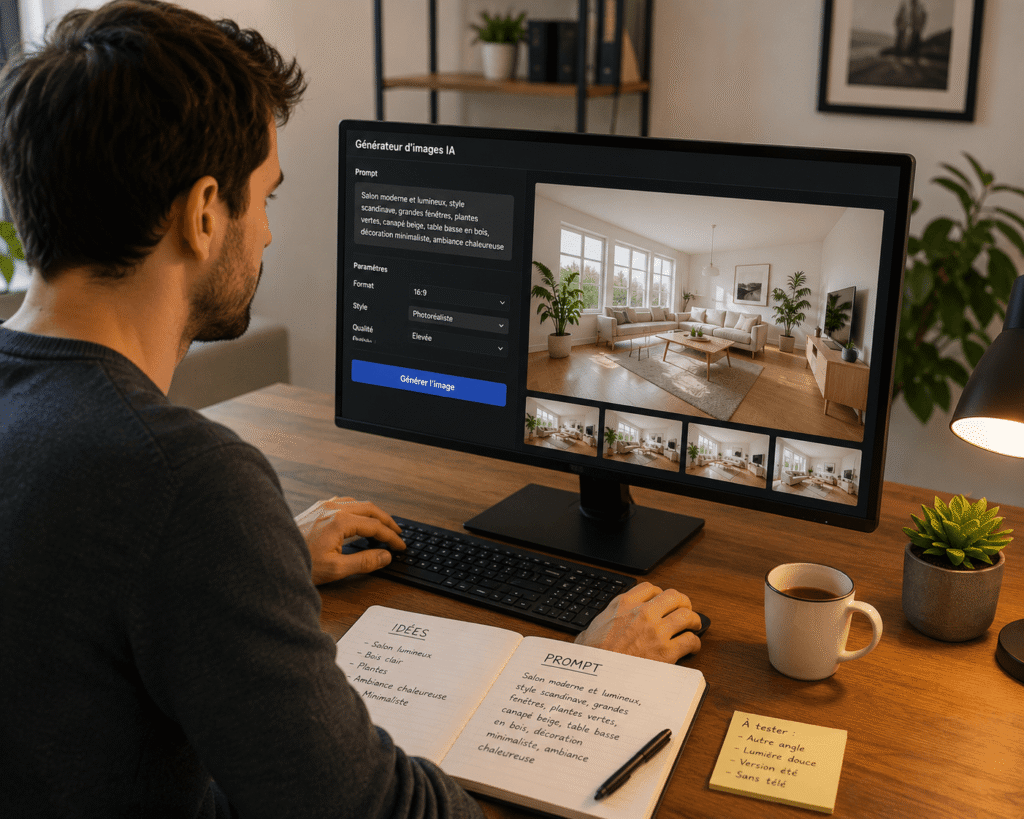
When a user enters a text prompt, the system interprets the request and generates a unique image that matches the description.
Most modern tools are based on diffusion models and advanced neural network architectures capable of producing highly realistic or artistic visuals.
If you’d like to understand the technical foundations behind these systems, you can explore this overview of artificial neural networks.
Why AI image generators are growing so fast
The rapid adoption of these tools can be explained by several advantages:
- Fast image creation
- Lower production costs
- Accessibility for non-designers
- Rapid creative experimentation
Rather than simply accelerating workflows, AI is changing how creators develop and explore ideas.
The most popular AI image-generation tools
DALL·E
Developed by OpenAI, DALL·E allows users to generate highly detailed images from natural language descriptions.
Its strengths include:
- Strong language understanding
- Consistent image composition
- User-friendly experience
You can learn more about the technology on the official DALL·E page.
Midjourney
Midjourney is particularly popular among artists and designers thanks to its highly stylized visual output and strong artistic direction.
Stable Diffusion
As an open-source solution, Stable Diffusion offers greater flexibility and customization. It is often favored by developers, advanced users, and organizations seeking full control over image generation.
Professional use cases today
Marketing and content creation
Marketing teams increasingly use AI-generated images for:
- Advertising creatives
- Social media visuals
- Blog illustrations
- Campaign concepts and text (with humanizer software)
This approach reduces production time while expanding creative possibilities.
Product design and prototyping
Designers use AI tools to quickly explore multiple visual directions before moving into traditional design software.
E-commerce
Many brands now generate:
- Product mockups
- Lifestyle product scenes
- Visual variations for catalogs
AI can dramatically accelerate content production for online stores.
Benefits of AI for creating images
- Significant time savings
- Reduced production costs
- Creative accessibility for beginners
- Rapid concept exploration
- Ability to generate countless variations
For many repetitive visual tasks, the productivity gains can be substantial.
Limitations you should know
No true understanding
AI does not truly understand the images it creates. It generates outputs based on statistical patterns learned during training.
Consistency issues
Complex scenes may still produce:
- Anatomical mistakes
- Unreadable text
- Visual inconsistencies
Legal and ethical questions
The use of training data has sparked ongoing debates around:
- Copyright
- Intellectual property
- Transparency of AI models
These issues remain central to discussions surrounding generative AI.
How to choose the right AI image generator
Your choice depends largely on your objectives:
- Ease of use and versatility: DALL·E
- Artistic creativity: Midjourney
- Customization and control: Stable Diffusion
The best tool is not necessarily the most powerful—it is the one that best fits your workflow and goals.
The future of AI image generation
Recent advances suggest that image quality will continue to improve rapidly.
Future developments may include:
- More consistent image generation
- Better contextual understanding
- Deeper integration into creative software
- Multimodal generation combining text, images, video, and audio
The most likely future is not one where AI replaces creators, but one where human creativity and artificial intelligence work together.
Conclusion
AI for creating images has become a major force in modern digital creativity.
It enables faster production, broader experimentation, and greater accessibility to visual creation. However, it does not replace human judgment, artistic vision, or creative experience.
The creators who achieve the best results will likely be those who use AI as a creativity amplifier rather than a substitute for human imagination.