Can a reliable AI text detector really tell whether something was written by ChatGPT, Claude, Gemini or a human? In 2026, that question matters more than ever. AI-generated writing has become increasingly fluent, making it difficult to identify its origin simply by reading it.
Schools, publishers, businesses and content teams now have access to dozens of AI detection tools promising to identify machine-generated text within seconds. But there is an important problem: AI detection is probabilistic, not definitive. False positives happen, human-edited AI text can be difficult to identify, and results can vary significantly from one detector to another.
So which AI detectors are actually useful — and how much should you trust their results? In this guide, we look at popular tools including GPTZero, Originality.ai, Scribbr and QuillBot, explain how AI detection works, and examine the limitations you need to understand before accusing a text of being AI-generated.
In short:
- No AI text detector can prove with certainty that a document was written by AI. Results should be interpreted as indicators rather than definitive evidence.
- GPTZero, Originality.ai, Scribbr and QuillBot are among the better-known AI detection tools available to users in 2026.
- Accuracy varies depending on the AI model, text length, language, editing and type of content being analyzed.
- Human-written text can be falsely flagged as AI-generated, making false positives particularly important in education and professional settings.
- Paraphrasing and human editing can make detection significantly more difficult.
- AI detectors are most useful when combined with context, source verification and human judgment.
Table of Contents
How does a reliable AI text detector actually work?
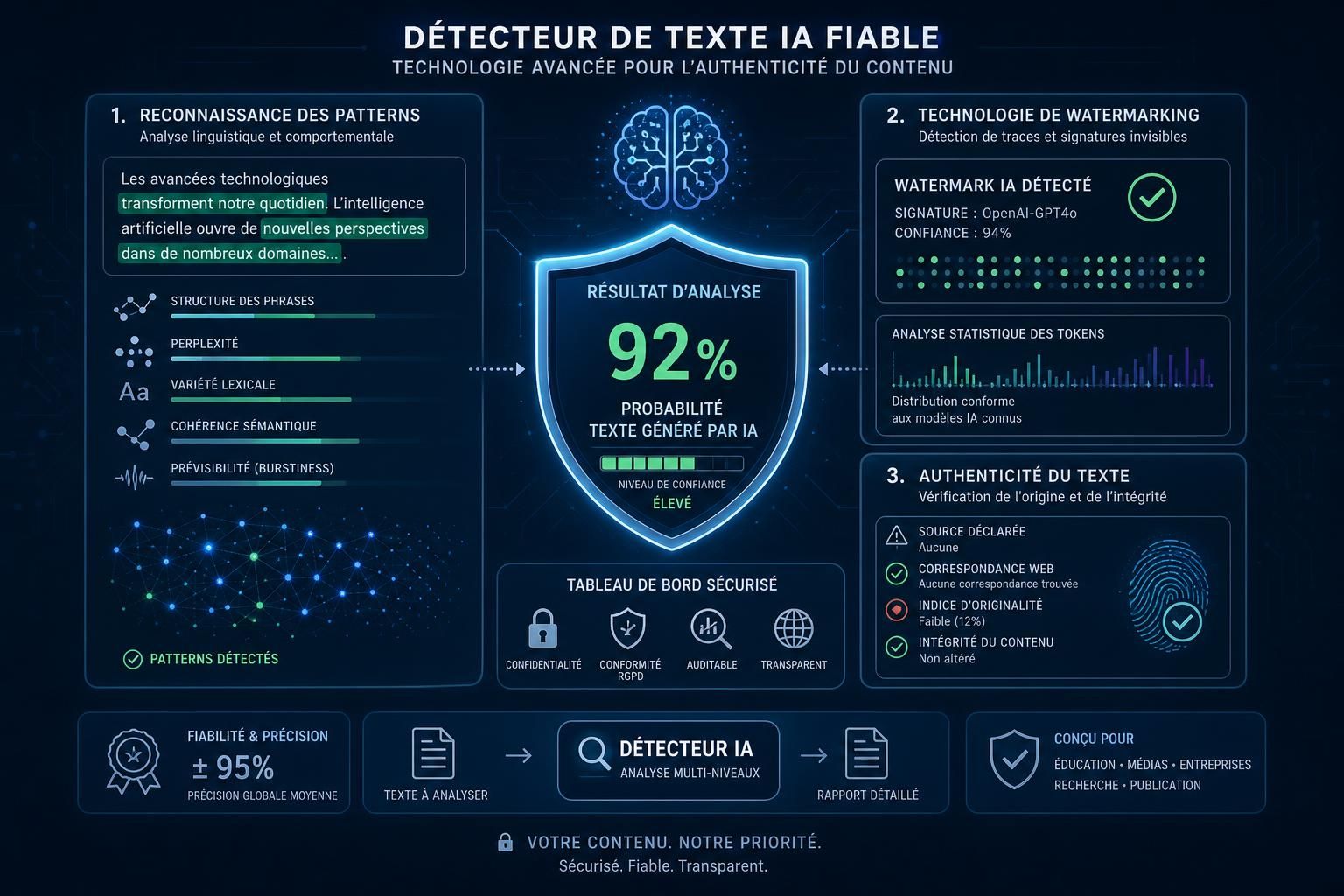
AI detectors do not normally “recognize ChatGPT” in the same way antivirus software recognizes a known malicious file. Instead, most detectors analyze patterns in a piece of writing and estimate how consistent those patterns are with machine-generated text.
The exact methods differ between providers, and commercial detection systems do not necessarily reveal every component of their models. However, several concepts are commonly associated with AI-text detection.
Perplexity and predictability
Perplexity is often used to describe how predictable a sequence of words is to a language model. AI-generated text can sometimes contain statistically predictable patterns because a language model selects words according to probabilities learned during training.
Human writing may contain more unusual choices, abrupt transitions, personal habits or irregular structures. But this distinction is not absolute. Modern AI models can generate highly varied prose, while humans can write extremely predictable text — particularly in technical, academic or formulaic contexts.
That is one reason a low-perplexity passage should never be treated as proof of AI authorship.
Burstiness and sentence variation
Another frequently discussed signal is burstiness: variation in sentence length, structure and complexity.
Human writers often move unpredictably between short statements and more elaborate sentences. Some AI-generated writing can appear more structurally uniform, particularly when generated with generic prompts.
Again, this is only a statistical tendency. A human can deliberately write in a consistent style, while a modern language model can easily be instructed to vary sentence structure. Reliable detection therefore requires more than checking whether paragraphs “sound robotic.”
Machine-learning classifiers and linguistic patterns
Modern AI detectors can use classifiers trained on examples of human-written and AI-generated text. These systems analyze combinations of linguistic and statistical features rather than relying on one obvious characteristic.
This is more sophisticated than looking for stereotypes such as excessive bullet points, em dashes or particular transition words. No individual punctuation habit reliably identifies ChatGPT, Claude or Gemini. Human writing styles vary enormously, and AI models can imitate many of those variations.
What about AI watermarking?
AI watermarking is an important research area, but it should not be confused with ordinary AI detection. A watermark can deliberately introduce a detectable signal into generated content so that compatible systems can later identify it.
In principle, this can provide stronger evidence than simply estimating whether a writing style looks machine-generated. In practice, text watermarking faces substantial challenges: the signal may be weakened by editing, translation, paraphrasing or moving content between different systems.
More importantly, you should not assume that every piece of text produced by a major AI assistant contains a universal hidden watermark that third-party detectors can reliably read. Watermark detection and statistical AI-text detection are separate concepts.
Best AI text detectors to try in 2026
There is no single detector that should be treated as a universal truth machine. Different tools use different models and thresholds, which means the same document can receive different classifications depending on where you test it.
Instead of looking for a detector that promises perfect accuracy, focus on transparency, usability, the type of content being analyzed and how clearly the tool communicates uncertainty.
GPTZero: a popular choice for education
GPTZero is one of the best-known names in AI-content detection and has developed a particularly strong presence in education.
The platform analyzes text and provides an assessment of whether content appears to have been written by a human, generated by AI or potentially contains a mixture of both. Its educational focus makes it relevant for teachers and institutions dealing with large volumes of written assignments.
However, a detection score should not be treated as sufficient evidence of academic misconduct by itself. Context, drafts, citations and the student’s writing process can provide important additional evidence.
Best for: educators and users who want a dedicated AI-detection platform with an education-oriented workflow.
Originality.ai: built for publishers and content teams
Originality.ai is primarily positioned toward professional publishers, website owners, agencies and content teams rather than casual users checking an occasional paragraph.
Its appeal comes from combining AI-content detection with tools relevant to editorial workflows. This can make it particularly useful for organizations reviewing large quantities of outsourced or internally produced content.
As with every detector, its output should be interpreted as a probability or risk signal rather than proof of authorship. Human editing, specialized writing and evolving AI models can all affect classification.
Best for: publishers, agencies, SEO teams and professional content workflows.
Scribbr: useful for students and academic writing
Scribbr is already widely associated with academic writing tools, including plagiarism checking, citation assistance and proofreading. Its AI detector therefore fits naturally into a student-oriented workflow.
For students and educators, the main advantage is convenience: AI detection can be used alongside other tools designed for reviewing academic work.
But plagiarism detection and AI detection should not be confused. A plagiarism checker searches for similarities with existing sources, while an AI detector attempts to classify the likely origin of writing based on patterns. A text can be entirely original and still be AI-generated — or completely human-written while containing plagiarism.
Best for: students and academic users who already use Scribbr’s broader writing tools.
QuillBot AI Detector: convenient for quick checks
QuillBot is best known for its paraphrasing and writing tools, but it also provides AI-content detection.
Its accessibility makes it convenient when you want to perform a quick preliminary check without adopting a dedicated professional detection platform.
That convenience should not encourage overconfidence. A quick detection score is useful as an initial signal, but important decisions should not depend on a single automated classification.
Best for: quick checks and users already working within QuillBot’s writing ecosystem.
aicheckr.io: another free AI detection option
aicheckr.io is another option for users looking to analyze text for possible AI generation. The service can be useful as an additional detector when comparing results across multiple tools.
Claims of extremely high detection accuracy should nevertheless be interpreted cautiously unless they are supported by independent testing across current AI models, multiple languages and both edited and unedited text.
This principle applies to every AI detector: provider-reported accuracy is not necessarily the same as real-world accuracy.
Best for: users looking for another detection signal to compare with established tools.
Reliable AI text detector comparison
| AI detector | Best for | Free access | AI detection | Main limitation |
|---|---|---|---|---|
| GPTZero | Education | Available | Yes | Results should not be treated as proof of misconduct |
| Originality.ai | Publishers and content teams | Primarily paid | Yes | Professional workflow may be unnecessary for casual users |
| Scribbr | Students and academic writing | Options vary | Yes | AI detection remains probabilistic |
| QuillBot | Quick checks | Available | Yes | Single scores should not determine important decisions |
| aicheckr.io | Additional detection checks | Available | Yes | Independent validation of performance should be considered |
How accurate are AI text detectors in 2026?
This is the most important question — and unfortunately there is no honest universal percentage.
An AI detector’s accuracy depends on several variables: which model generated the text, whether the content was edited, its length, language, writing style and whether the detector was trained on similar material.
A detector can perform extremely well on one benchmark and considerably worse when confronted with a newer model or a different type of writing. This is particularly important in 2026 because generative AI models evolve rapidly.
There are also two different types of error to consider. A false negative occurs when AI-generated text is classified as human. A false positive is potentially more serious: human writing is incorrectly classified as AI-generated.
For that reason, claims such as “98% accurate” are incomplete unless they explain the dataset, models tested, languages, false-positive rate, text length and testing methodology.
A reliable AI detector should communicate uncertainty rather than pretending that every result is certain.
Why AI detectors can produce false positives
False positives are one of the biggest limitations of automated AI detection because they reverse the burden of proof: a person who genuinely wrote something may suddenly be expected to demonstrate that they did not use AI.
Formulaic writing can be particularly difficult to classify. Technical explanations, standardized business language, simple academic prose and highly structured documents may contain predictable patterns that resemble machine-generated writing.
Writers using a second language can also produce grammatical structures or vocabulary patterns that differ from those expected by a detector’s training data. This is one reason institutions should be especially cautious when AI-detection results could lead to disciplinary consequences.
A high AI probability should therefore trigger further investigation, not an automatic accusation.
Why edited and paraphrased AI text is harder to detect
Detection becomes more difficult when AI-generated text is substantially rewritten. This makes intuitive sense: if a detector is searching for statistical patterns associated with machine generation, changing those patterns can reduce the strength of the signal.
Human editing can change vocabulary, sentence structure, rhythm and organization. Translation can transform those characteristics even further. The resulting text may no longer resemble the original AI output closely enough for a classifier to identify it confidently.
This does not mean paraphrasing automatically defeats every detector. It means that classification becomes more uncertain as the relationship between the analyzed text and the original generation changes.
Why short texts are difficult to classify
Short passages provide less statistical information. A detector examining several pages can observe repeated patterns in sentence structure, vocabulary and predictability. A detector examining two sentences has far less evidence to work with.
This is why users should be skeptical of highly confident classifications based on tiny samples. A short email, social-media post or isolated paragraph may simply not contain enough information for robust attribution.
If possible, analyze a larger representative sample rather than selecting the sentence that happens to look suspicious.
Can an AI detector tell whether ChatGPT wrote a text?
Usually, not with the level of certainty implied by that question.
A detector may estimate that a text resembles AI-generated writing, and some services may attempt more granular classification. But distinguishing reliably between output from ChatGPT, Claude, Gemini and other modern language models is substantially harder than simply separating obvious machine-generated text from human writing.
The models themselves change, prompts strongly influence writing style, and users frequently edit generated content before publishing it. A confident claim that a detector can identify the exact model behind arbitrary text should therefore be supported by strong independent evidence.
Stylistic stereotypes are not enough. ChatGPT does not own bullet points, Claude does not have a unique sentence rhythm and Gemini cannot be identified simply by punctuation.
How to choose a reliable AI text detector
Instead of choosing the service with the highest advertised accuracy number, evaluate how transparent and useful the detector is in your actual workflow.
- Look for independent testing: provider claims are useful, but external evaluations provide another perspective.
- Check false-positive performance: correctly identifying AI is only half the problem; human writing must also be protected from incorrect classification.
- Consider the models tested: performance against older AI systems may tell you little about current models.
- Check language support: a detector that performs well in English may not perform equally well in every language.
- Prefer detailed results: sentence-level analysis and clear explanations are more useful than an unexplained percentage.
- Understand the privacy policy: do not upload confidential, unpublished or personally sensitive material without knowing how the service handles it.
- Never rely on one score alone: important decisions require contextual evidence and human review.
Should schools use AI detectors?
AI detection can be useful in education, but this is also where misuse can cause some of the greatest harm.
A detector can help identify assignments that deserve closer examination. Teachers can then compare the work with previous submissions, ask students to explain their reasoning, examine drafts or revision history, and verify whether cited sources actually support the claims being made.
What an AI detector should not become is an automated judge. A probability score alone does not establish who wrote a document, how it was produced or whether a student violated a particular policy.
Institutions should therefore establish clear procedures for how detection results are interpreted and what additional evidence is required before disciplinary action is considered.
AI detection for publishers, SEO teams and businesses
Publishers and businesses face a somewhat different problem. The goal is often not to prove that AI was used, but to maintain quality, originality, accuracy and compliance with an editorial process.
An AI detector can be one component of that process, particularly when organizations need to review large quantities of outsourced content. But detecting AI does not tell you whether an article is accurate, useful or original.
A human-written article can contain fabricated facts. An AI-assisted article can be carefully researched, edited and fact-checked. For publishers, content quality and evidence matter more than a simplistic human-versus-AI label.
Plagiarism detection, citation verification, source checking and editorial review therefore remain important even when an AI detector is part of the workflow.
Can AI detectors be trusted?
AI detectors can be useful. They simply need to be used for the right purpose.
If you use a detector to answer “Should I investigate this text more closely?”, its output can provide a valuable signal. If you use it to answer “Can I prove beyond doubt that this person used ChatGPT?”, you are asking the technology to provide a level of certainty it generally cannot guarantee.
For important decisions, consider using more than one source of evidence: detection results, document history, previous writing samples, citations, metadata where appropriate, and direct discussion with the author.
The most trustworthy approach in 2026 is therefore surprisingly simple: use AI detection as evidence to evaluate, not as a verdict to obey.
Reliable AI text detector FAQ
What is the most reliable AI text detector in 2026?
There is no detector that should be treated as definitive for every type of text. GPTZero, Originality.ai, Scribbr and QuillBot are among the better-known options, but the most reliable approach is to treat their results as signals and combine them with additional evidence.
Can AI detectors be 100% accurate?
No. Performance varies according to the AI model, language, text length, writing style and amount of editing. False positives and false negatives remain possible, so claims of universal or near-perfect accuracy deserve careful scrutiny.
Can an AI detector tell if ChatGPT wrote something?
It may estimate that a passage resembles AI-generated writing, but identifying ChatGPT specifically is much more difficult. Modern models can produce overlapping styles, and human editing makes attribution even harder.
Can human writing be detected as AI?
Yes. This is known as a false positive. Human-written text can sometimes be classified as AI-generated, which is why automated scores should never be the sole basis for serious accusations or disciplinary decisions.
Does paraphrasing fool AI detectors?
Substantial rewriting can make detection more difficult because it alters the linguistic patterns a detector analyzes. That does not guarantee that rewritten AI content will evade detection, but it can reduce confidence in the classification.
Should teachers trust AI detectors?
Teachers can use AI detectors as one source of information, but not as an automated verdict. A stronger investigation combines detection results with drafts, revision history, previous writing, citations and discussion with the student.