ChatGPT vs Claude: which AI assistant is actually better in 2026? The answer is no longer as simple as comparing two chatbots. Both platforms have evolved into powerful AI workspaces capable of helping with coding, research, writing, document analysis and complex professional tasks.
But they do not offer exactly the same experience. Claude has developed a particularly strong reputation around coding, long-context work and complex professional workflows, while ChatGPT offers a broader all-purpose environment combining advanced reasoning with web research, data analysis, file handling, image generation, voice and other integrated tools.
That makes the real question less about which AI is universally “smarter” and more about which one is better for what you actually want to accomplish. In this ChatGPT vs Claude comparison, we examine their strengths, weaknesses and most important differences to help you choose the right AI in 2026.
In short:
- Claude is particularly compelling for coding, long-context tasks and complex document-based workflows.
- ChatGPT stands out as a highly versatile general-purpose AI workspace with reasoning, research, coding, image generation, voice and data-analysis capabilities.
- Both are capable of strong writing and programming, so there is no honest universal winner for every prompt.
- The quality of the result depends heavily on the model, tools, prompt, task and amount of context provided.
- For many professionals, the decision ultimately comes down to specialized workflow versus broader versatility.
Table of Contents
ChatGPT vs Claude: the biggest differences in 2026
Comparing ChatGPT and Claude solely by asking each model the same ten questions is no longer enough. Modern AI assistants are increasingly defined by the complete environment around their models: tools, memory, file handling, research capabilities, integrations, coding agents and the amount of work they can perform across multiple steps.
Claude, developed by Anthropic, has become especially prominent in professional knowledge work and software development. Anthropic continues to invest heavily in Claude Code and agentic workflows, while its recent models are designed to handle coding, tool use and demanding professional tasks.
ChatGPT, developed by OpenAI, takes a broader approach. Depending on the plan and available features, users can combine conversational AI with web research, file analysis, coding tools, image generation, voice interactions and other capabilities inside the same product.
This distinction matters. Claude often feels like a highly focused collaborator for deep knowledge work, while ChatGPT increasingly behaves like a general-purpose AI workspace. There is considerable overlap, but the surrounding product experience can matter just as much as raw model intelligence.
ChatGPT vs Claude for coding: which is better?
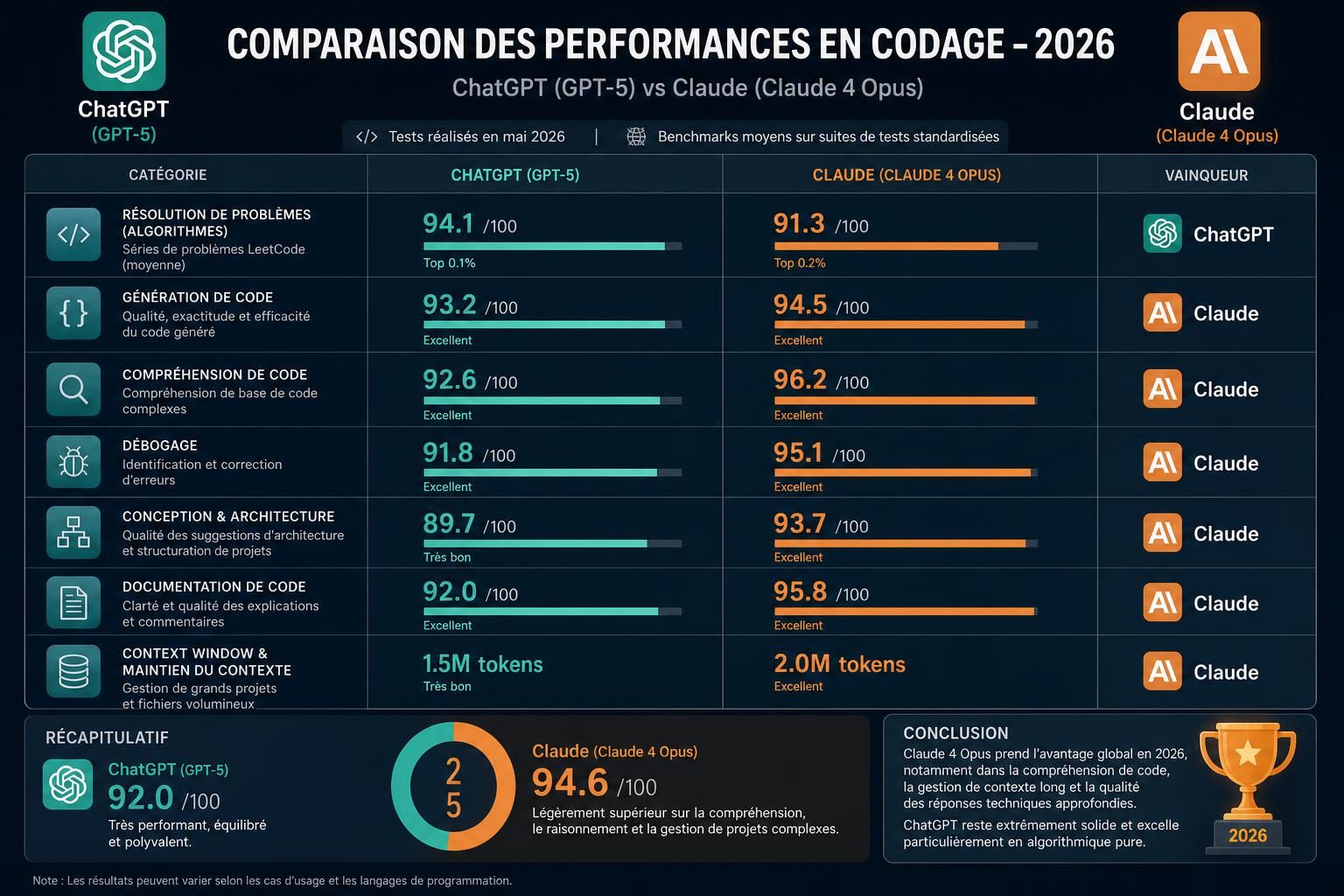
Coding is one of the most competitive areas in the Claude vs ChatGPT debate. Both can explain code, identify bugs, generate functions, refactor existing projects and help developers reason through architectural problems.
Claude has a particularly strong position here because Anthropic has made software development a central part of its product strategy. Claude Code is designed for agentic coding workflows in which the AI can inspect a codebase, understand relationships between files, make changes and work through multi-step development tasks.
This makes Claude attractive for developers dealing with large repositories, refactoring, debugging and tasks that require the AI to maintain an understanding of a project across multiple files.
ChatGPT is also a serious coding tool. It can generate and analyze code, work with uploaded files, reason through programming problems and use dedicated coding capabilities depending on the available plan and environment. Its broader tool ecosystem can also be useful when a programming task intersects with research, data analysis, documentation or other types of work.
Be careful with claims that one assistant is simply “95% accurate” while another is “85% accurate.” Coding benchmarks measure specific tasks under specific conditions, and rankings can change quickly as models and agent frameworks are updated. A model that wins one benchmark is not automatically better for every programming language, repository or real-world development workflow.
Verdict: Claude is an excellent choice if AI-assisted software development is your main priority, particularly for agentic and repository-level workflows. ChatGPT remains highly competitive and may be more attractive if coding is only one part of a broader AI workflow.
ChatGPT vs Claude for writing and long documents
Writing is much harder to benchmark than coding because quality depends on tone, audience and personal preference. Both ChatGPT and Claude can produce excellent emails, articles, reports, summaries, marketing copy and long-form documents when given clear instructions.
Claude has traditionally been particularly attractive for long-form writing and document-heavy workflows. Its long-context capabilities allow compatible models and products to work with substantial amounts of information, making Claude useful for analyzing reports, technical documentation, research material and large collections of text.
That can matter when the challenge is not simply generating 500 words, but maintaining consistency while reasoning across a large body of source material.
ChatGPT is also highly capable at writing and editing. One of its strengths is versatility: the same workspace can be used to research a subject, analyze source material, restructure content, work with files and then transform the result into different formats.
Neither assistant should automatically be considered more factual simply because its prose sounds confident or polished. Both AI systems can make mistakes and generate unsupported claims. For research, journalism, academic work or important business decisions, source verification remains essential.
Verdict: Claude is particularly compelling for long documents and sustained text-heavy workflows. ChatGPT is a strong alternative when writing is combined with research, analysis or other tools.
ChatGPT has an advantage in multimodal creation
This is one of the areas where the difference between the two products becomes easier to see. ChatGPT is not limited to text generation. OpenAI has built multimodal capabilities into the broader ChatGPT experience, allowing supported users to work across text, images, files and voice.
Image generation is particularly important for creators. Instead of using one AI to write a concept and another service to visualize it, users can generate and iterate on images from within the same conversational workflow.
Voice capabilities further expand the range of possible uses, from hands-free conversations and brainstorming to language practice and interactive assistance.
Claude is multimodal in the sense that compatible Claude models can understand visual information and work with uploaded documents and images. However, its product positioning is more heavily centered on reasoning, coding and knowledge work than on providing an integrated creative-media suite.
Verdict: if generating and working across multiple media types is central to your workflow, ChatGPT generally offers the more complete all-in-one environment.
Claude vs ChatGPT for long context and document analysis
Context windows determine how much information a model can consider during a task, but the advertised number alone does not tell the entire story. Effective recall, retrieval, reasoning quality and the way a product manages long conversations are equally important.
Anthropic has made long-context processing one of Claude’s major strengths. Recent Claude models support very large context configurations, making the platform particularly interesting for developers, researchers and professionals working with substantial codebases or document collections.
ChatGPT can also work with large files and extensive conversations, but comparing the two platforms using a single context-window number can be misleading because limits can differ by model, plan, product surface and API configuration.
More context is also not automatically better. A one-million-token window provides little advantage if your task only requires a five-page document. For ordinary users, the quality of retrieval and reasoning over the relevant information is usually more important than the theoretical maximum.
Verdict: Claude remains particularly attractive for extremely context-heavy workloads, but choose based on the amount of information you genuinely need to process rather than headline token counts alone.
ChatGPT vs Claude comparison table
| Category | ChatGPT | Claude |
|---|---|---|
| Coding | Excellent general coding capabilities with a broader tool ecosystem | Particularly strong focus on agentic coding and repository-level workflows |
| Long documents | Strong file analysis and document workflows | Excellent long-context capabilities and document-heavy workflows |
| Writing | Versatile writing, editing and structured content creation | Particularly strong for nuanced and sustained long-form work |
| Research | Strong research and web-enabled workflows | Strong reasoning and research-oriented workflows |
| Image understanding | Yes | Yes on supported models |
| Image generation | Integrated image-generation capabilities | Not a core native creation feature in the same way |
| Voice | Advanced conversational voice capabilities | Product capabilities vary and are less central to the experience |
| Developer tools | API, coding tools and broad ecosystem | API, Claude Code and strong agentic development focus |
| Best suited to | Users wanting a versatile all-in-one AI assistant | Developers and professionals focused on deep knowledge work |
ChatGPT vs Claude pricing: is one better value?
Price is another area where comparisons need to be made carefully. Both companies offer multiple tiers, and subscription prices, usage limits and included models can change over time.
ChatGPT offers a free tier alongside paid consumer plans. In the United States, OpenAI currently lists ChatGPT Go at $8 per month, ChatGPT Plus at $20 per month and ChatGPT Pro at $200 per month, although pricing can vary by market.
Claude also offers free and paid access, with different tiers designed for individual and heavier professional use. The most important consideration is not simply the monthly price but what level of model access, usage limits and specialized tools you actually receive for your workflow.
A $20 subscription is poor value if you constantly hit the limits required for your work. Conversely, paying for the most expensive tier makes little sense if you only use AI for occasional emails and summaries.
Because AI pricing and usage limits change frequently, verify the current plans directly with OpenAI and Anthropic before subscribing.
Which AI is better for professional work?
For professional users, the winner depends heavily on the workflow rather than the benchmark leaderboard.
A software engineer may value Claude Code and Claude’s emphasis on agentic development. A researcher dealing with large collections of documents may prioritize context handling. A marketer may prefer an environment where text, research and visual creation can coexist. A consultant might care more about file analysis, web research and the ability to move rapidly between different types of tasks.
Companies also need to consider factors that individual comparisons often ignore: data policies, administrative controls, security requirements, integrations, API costs and how easily an assistant fits into existing internal processes.
This is why asking “Which model scored higher?” is often the wrong starting point. The better question is: which platform removes the most friction from the work you perform every day?
Should you use both ChatGPT and Claude?
For heavy AI users, the answer may actually be yes. ChatGPT and Claude overlap considerably, but their differences can make them complementary rather than mutually exclusive.
A developer might use Claude for demanding codebase work while using ChatGPT for research, data analysis, image creation and general productivity. A writer could draft or analyze a long document with Claude and use ChatGPT for research or multimedia assets.
There is also a useful reliability benefit to having access to more than one model: when an answer matters, asking a second independent system to challenge assumptions or identify missing evidence can expose weaknesses in the first response.
That does not mean everyone should pay for two subscriptions. For casual users, the overlap is too large to justify it. But professionals who use AI every day may gain more from combining specialized strengths than from obsessing over which company has the single “best” model.
ChatGPT or Claude: which one should you choose?
If you only want to pay for one AI assistant, start with your primary use case.
- Choose Claude if: coding and complex software-development workflows are central to your work.
- Choose Claude if: you regularly work with very long documents, large codebases or context-heavy professional tasks.
- Choose ChatGPT if: you want one AI environment capable of handling a broad variety of everyday tasks.
- Choose ChatGPT if: image generation, voice, research, data analysis and multimodal workflows are important to you.
- Consider both if: AI is a major productivity tool in your professional workflow and the additional subscription cost can be justified by the time saved.
There is therefore no credible universal answer to ChatGPT vs Claude. Claude is an exceptionally capable platform for coding and deep knowledge work, while ChatGPT’s major strength is the breadth of what can be accomplished inside a single AI environment.
The smartest choice is not to follow whichever AI happens to be trending this month. Identify the tasks that consume the most time in your workflow, test both assistants on those exact tasks, and keep the one that consistently produces the most useful results.
ChatGPT vs Claude FAQ
Is Claude better than ChatGPT in 2026?
Not for every task. Claude is particularly compelling for coding, long-context work and complex document workflows. ChatGPT offers a broader general-purpose environment combining reasoning with research, coding, image generation, voice and data analysis.
Is Claude better than ChatGPT for coding?
Claude is an excellent choice for serious software-development workflows, particularly when using Claude Code for agentic and repository-level tasks. ChatGPT is also highly capable and becomes especially attractive when programming is combined with other types of work.
Is ChatGPT or Claude better for writing?
Both can produce high-quality writing. Claude is particularly attractive for sustained long-form and document-heavy work, while ChatGPT is highly versatile for writing, editing, research and structured content creation.
Which is better for long documents, ChatGPT or Claude?
Claude has a strong position in long-context workflows and supports very large context configurations on compatible models. ChatGPT can also analyze substantial files and documents, so the practical difference depends on the model, plan and type of material being analyzed.
Can ChatGPT generate images?
Yes. ChatGPT provides integrated image-generation capabilities in supported experiences, allowing users to create and refine visuals through natural-language instructions.
Should I pay for both ChatGPT and Claude?
Probably not if you only use AI occasionally. If AI is central to your professional workflow, however, using both can make sense because their strengths are complementary rather than identical.