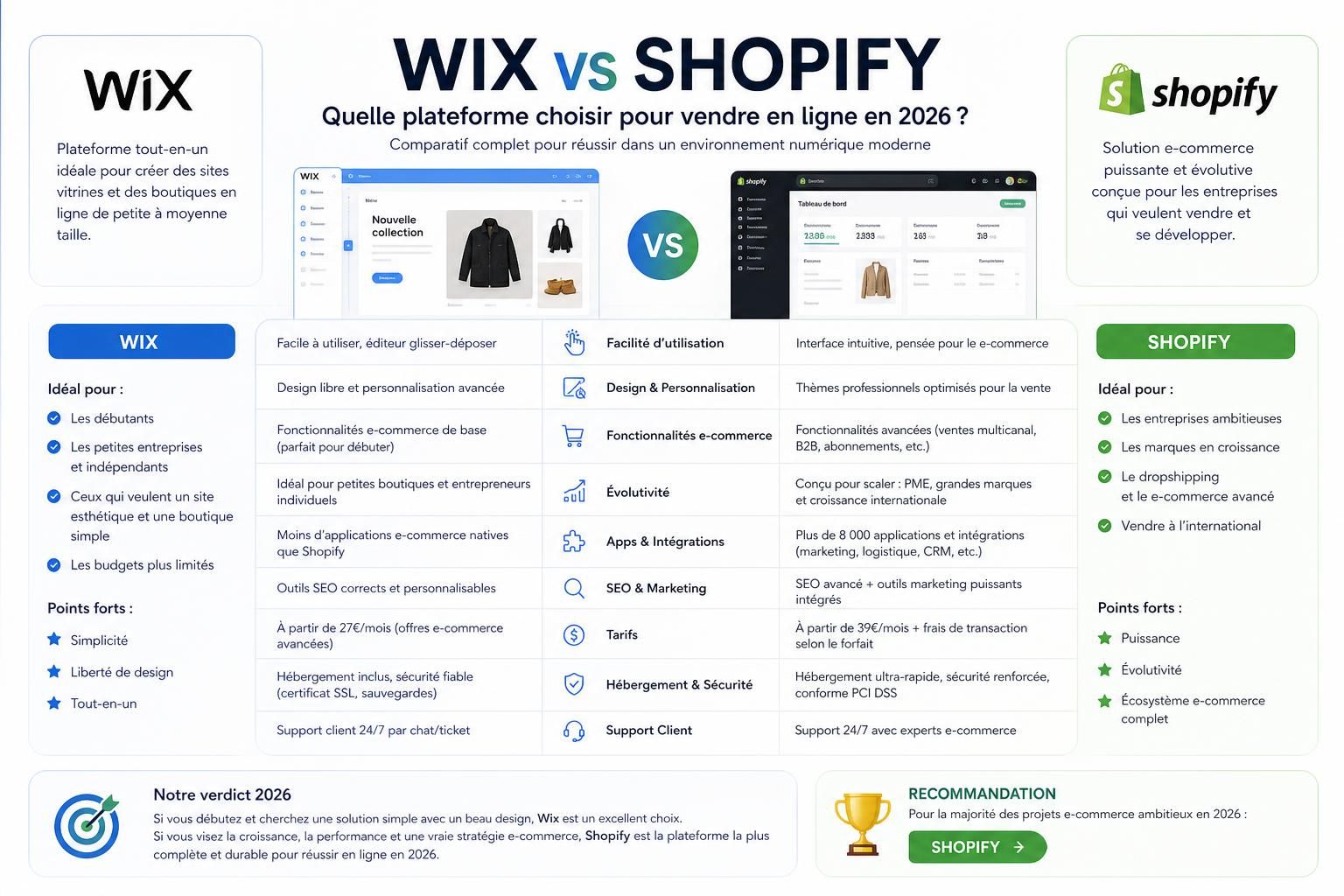
Choosing between Wix vs Shopify can have a major impact on how easily you launch, manage and grow an online store. Both platforms can handle ecommerce, but they were built with very different priorities.
Shopify is an ecommerce-first platform designed around products, payments, inventory, orders and multichannel selling. Wix takes a broader approach, combining website creation, ecommerce, blogging, bookings and marketing tools within the same ecosystem.
So which one should you choose in 2026? The answer depends less on which platform is “better” overall and more on what you actually want to build. A small business selling 50 products alongside services has very different requirements from an international ecommerce brand managing thousands of SKUs.
In this Wix vs Shopify comparison, we look at ease of use, ecommerce features, inventory management, SEO, marketing, scalability and long-term costs to help you choose the right platform for your online store.
In short:
- Shopify is the stronger ecommerce-first platform for stores focused heavily on online selling, large catalogs and long-term scalability.
- Wix is particularly attractive for small businesses that want to combine an online store with content, services, bookings and a broader business website.
- Wix gives beginners considerable visual control without requiring coding knowledge for most everyday website changes.
- Shopify has a particularly mature ecommerce ecosystem with extensive apps, integrations and tools for growing merchants.
- Both platforms provide important SEO and marketing tools, although their technical structures and customization options differ.
- The best choice depends on your business model, catalog size, technical needs and expected growth.
Table of Contents
Wix vs Shopify: the biggest difference
The most important difference between Wix and Shopify is not a specific feature. It is the philosophy behind each platform.
Shopify was built around ecommerce. Products, inventory, checkout, orders, payments and sales channels sit at the center of the experience. This makes the platform particularly attractive to businesses where selling products online is the primary activity.
Its ecosystem reinforces that specialization. Merchants can connect their stores to a wide range of apps, logistics services, marketing tools and sales channels as their operations become more sophisticated.
Wix started from the opposite direction. It developed primarily as a website builder before expanding its ecommerce capabilities. Selling online is therefore one component of a broader website-building ecosystem.
That distinction can be an advantage for small businesses. A restaurant, consultant, fitness professional or local retailer may want to publish content, accept bookings, showcase services, collect leads and sell products without managing several separate platforms.
For example, a catering business could publish recipes, showcase previous events, accept bookings and sell gift boxes through the same Wix website.
The first question is therefore simple: are you building an ecommerce business, or a broader business website that also needs ecommerce?
If ecommerce is the core of the business and you expect significant growth, Shopify has a natural advantage. If selling products is only one part of a broader online presence, Wix can be extremely compelling.
Wix vs Shopify for ease of use
Ease of use matters more than many entrepreneurs expect. The easier your store is to manage, the less frequently you need outside technical assistance for everyday changes.
Wix is particularly accessible to beginners. Its visual website-building approach gives users substantial control over layouts and content without requiring them to write code.
This can make Wix attractive to freelancers, local businesses and small teams that want to build and maintain their own website. Changing text, adding pages, publishing articles or updating visual sections can generally be handled directly through the editor.
Shopify is also designed to be accessible, particularly for standard ecommerce tasks. Adding products, managing orders and configuring the basic store experience does not require advanced development knowledge.
The difference becomes more noticeable when you want to move beyond the standard structure of your chosen theme. Advanced Shopify customization can involve its theme architecture and Liquid templating language, depending on the changes required.
This does not make Shopify difficult. In fact, its more structured approach can be an advantage for ecommerce because it creates consistency across product and collection pages.
But if your priority is maximum visual freedom without coding, Wix is likely to feel more intuitive.
Ease of use: quick verdict
- Wix: excellent visual flexibility and beginner-friendly website management.
- Shopify: straightforward for ecommerce management with a more structured store-building approach.
- Best for beginners: Wix has an advantage when design freedom and general website management are priorities.
- Best for ecommerce workflows: Shopify’s structure becomes increasingly valuable as the store grows.
Wix vs Shopify for ecommerce features
This is where Shopify’s ecommerce-first philosophy becomes most obvious.
Shopify is designed to manage the entire commercial workflow: products, variants, inventory, orders, payments, shipping and connections with additional sales channels.
For a growing retailer, this specialized infrastructure can become increasingly important. A store selling thousands of products across different channels has fundamentally different requirements from a local business selling a relatively small catalog.
Wix Stores covers the core requirements of many small and medium-sized ecommerce businesses. Merchants can manage products, inventory, discounts, orders and shipping while connecting ecommerce with the rest of their website.
For businesses with dozens or hundreds of products, the practical difference may therefore be smaller than expected.
The gap becomes more relevant as operational complexity increases. If your roadmap involves a very large catalog, sophisticated inventory management, international expansion or an extensive network of ecommerce integrations, Shopify is generally the more natural platform to investigate first.
The key is to avoid paying for complexity you do not need while also avoiding a platform that could become restrictive if your business scales rapidly.
Wix vs Shopify ecommerce comparison
| Feature | Wix | Shopify |
|---|---|---|
| Core ecommerce | Strong for small and medium-sized stores | Built specifically around ecommerce |
| Inventory management | Suitable for many standard business needs | Better suited to increasingly complex retail operations |
| Large catalogs | Suitable depending on catalog complexity | Strong choice for large and growing catalogs |
| Discounts and promotions | Available | Available with extensive ecommerce options |
| Shipping | Supports standard ecommerce shipping workflows | Extensive ecommerce and integration ecosystem |
| Abandoned carts | Available | Available |
| App ecosystem | Broad business-app ecosystem | Particularly extensive ecommerce ecosystem |
| Best fit | Small businesses combining ecommerce with a broader website | Businesses where ecommerce is the central activity |
Wix vs Shopify for SEO
SEO is an important consideration when choosing an ecommerce platform because organic search can become a major source of long-term traffic and sales.
The good news is that both Wix and Shopify provide the fundamental SEO features needed to build a search-friendly website.
Wix allows users to manage important elements such as page titles, meta descriptions, headings, redirects and other SEO settings. Its integrated blogging and website-building tools can also make it convenient to build a content strategy around your commercial pages.
That can be particularly useful for businesses using informational content to attract users before directing them toward products or services.
Shopify also provides a solid SEO foundation and automatically handles several technical elements. Its standardized ecommerce architecture can simplify management, although parts of its URL structure are more opinionated than on some other platforms.
However, it would be a mistake to choose Wix or Shopify solely because someone claims one platform automatically “ranks better” on Google.
Your platform does not replace an SEO strategy. Search performance still depends heavily on content quality, search intent, internal linking, site architecture, technical performance, backlinks and the competitiveness of your market.
For content-heavy small businesses, Wix’s combination of website editing, blogging and ecommerce can be convenient. For large ecommerce operations, Shopify’s specialized architecture and ecosystem can make scaling an SEO program easier operationally.
Wix vs Shopify for marketing
Both platforms extend far beyond simply displaying products and accepting payments.
Wix’s strength is centralization. Businesses can combine their website, store, blog, lead generation, bookings and various marketing activities within the same broader ecosystem.
This is particularly useful for businesses that sell both products and services. A photographer, coach or local retailer may value having different parts of the customer journey managed from one platform.
Shopify’s marketing strength comes from its ecommerce specialization and ecosystem. Businesses can extend the platform with integrations for advertising, email marketing, analytics, customer retention and multichannel selling.
As the business becomes more sophisticated, that ecosystem can be a major advantage. The trade-off is that a growing Shopify stack may involve additional apps, subscriptions and operational complexity.
Wix vs Shopify pricing: which is cheaper?
Comparing Wix and Shopify purely by the advertised monthly subscription can be misleading.
The more useful metric is total cost of ownership: the platform subscription, payment processing, paid themes, apps, additional services and any development work required to build and maintain the store.
For a relatively simple business website with ecommerce functionality, Wix can be cost-effective because several website and marketing capabilities are available within the same ecosystem.
Shopify can become more expensive as merchants add specialized applications or require custom development. However, those costs may be entirely justified when the additional functionality supports a larger ecommerce operation.
Pricing and plan features change over time, so avoid choosing based on an outdated comparison table. Calculate what your actual setup would cost today, including the apps and functionality you genuinely need.
Which platform is better for a small business?
For many small businesses, Wix can be the more practical starting point when ecommerce is only one part of the company’s online presence.
Imagine a local business that needs a homepage, service pages, a blog, appointment booking, contact forms and a small online store. Wix’s broad website-building approach fits this type of project naturally.
The business owner can also retain substantial control over everyday changes without necessarily relying on a developer.
But “small business” does not automatically mean Wix.
If you are launching a small company whose entire business model revolves around ecommerce and you expect the catalog, sales volume and operational complexity to grow quickly, starting directly with Shopify can make more sense.
The decision should be based on where the business is going, not simply where it is today.
Which platform is better for a growing ecommerce store?
This is where Shopify has its clearest advantage.
A growing ecommerce operation eventually needs more than attractive product pages. Inventory becomes more complex, sales channels multiply, fulfillment requirements evolve and marketing systems become increasingly specialized.
Shopify is built around that progression. Its ecosystem gives merchants considerable room to expand the functionality of their stores as new requirements appear.
This does not mean every successful Wix store eventually needs to migrate. Many businesses can remain comfortably within Wix if their operational requirements stay relatively straightforward.
But if your business plan already anticipates thousands of products, international expansion, multiple sales channels and increasingly sophisticated logistics, Shopify provides a stronger foundation for that trajectory.
Wix vs Shopify: which one should you choose in 2026?
The final decision becomes much easier once you stop asking which platform is universally better and start asking which one matches your business model.
Choose Wix if:
- You want to combine a business website and online store.
- You sell a relatively manageable catalog of products.
- Visual editing and ease of use are major priorities.
- You also need content, bookings, services or lead-generation features.
- You want to manage most everyday website changes yourself.
Choose Shopify if:
- Ecommerce is the core of your business.
- You expect significant growth in products, orders or sales channels.
- You need a large ecosystem of specialized ecommerce integrations.
- You expect increasingly sophisticated inventory or fulfillment requirements.
- International and multichannel expansion are important to your long-term strategy.
For a local business, freelancer or small company combining services and ecommerce, Wix may offer the better balance of simplicity and versatility.
For a business built primarily around selling products online — especially one expecting substantial growth — Shopify is generally the stronger long-term ecommerce choice.
The best platform is therefore not necessarily the one with the longest feature list. It is the one whose complexity matches the business you are actually trying to build. For other comparison, click here.
Wix vs Shopify FAQ
Is Wix or Shopify better for ecommerce?
Shopify is generally stronger for ecommerce-first businesses, particularly when substantial growth and operational complexity are expected. Wix is particularly attractive for businesses that want ecommerce alongside content, services, bookings or other website functionality.
Is Wix or Shopify better for a small business?
Wix can be an excellent choice for a small business that needs an all-in-one website and online store. However, a small ecommerce-first company expecting rapid growth may benefit from starting directly with Shopify.
Is Wix or Shopify better for SEO?
Both provide the essential tools needed for SEO. Wix offers considerable flexibility for website and content management, while Shopify provides a strong ecommerce-oriented structure. Neither platform guarantees better rankings: content, technical execution, internal linking, backlinks and competition remain critical.
Is Shopify easier to use than Wix?
It depends on the task. Wix provides a highly visual website-building experience, while Shopify provides a more structured environment centered around ecommerce. Beginners focused on general website creation may prefer Wix, while merchants may appreciate Shopify’s specialized workflow.
Can you move from Wix to Shopify later?
Yes. A migration is possible, but it should be planned carefully. Products, content, URLs, metadata and redirects all need attention, particularly if the existing Wix website already receives organic search traffic.
Which is cheaper, Wix or Shopify?
There is no universal answer. Compare the total cost of ownership, including the subscription, payment processing, apps, themes and development work required for your specific store.